AI is transforming smart manufacturing by optimizing operations and enhancing productivity. It achieves this through applications like predictive maintenance and real-time quality control. However, the integration of AI also introduces complexities, particularly concerning data security and workforce reskilling. As the manufacturing landscape evolves, understanding the implications of these advancements becomes crucial. The balance between technological innovation and ethical practices may shape the future trajectory of the industry. What challenges lie ahead in this intersection?
How AI Enhances Efficiency in Smart Manufacturing
As industries increasingly adopt smart manufacturing practices, the integration of artificial intelligence (AI) stands out as a pivotal factor in enhancing operational efficiency.
AI facilitates predictive maintenance, allowing companies to anticipate equipment failures and minimize downtime.
Additionally, it drives process optimization by analyzing vast data sets to identify inefficiencies, ultimately leading to streamlined operations and increased productivity, empowering organizations to operate with greater agility and responsiveness.
Key Applications of AI in Manufacturing Processes
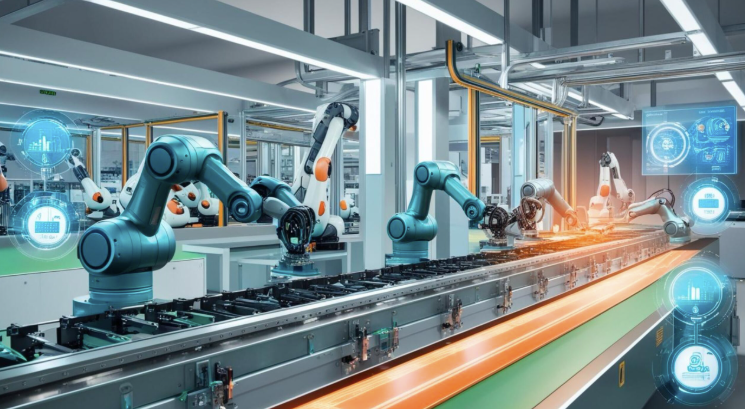
AI revolutionizes manufacturing processes through diverse applications that enhance productivity and quality.
Notable implementations include predictive maintenance, which anticipates equipment failures, thereby minimizing downtime and associated costs.
Additionally, AI-driven quality control systems analyze product specifications in real-time, ensuring adherence to standards and reducing defects.
These technologies collectively empower manufacturers to optimize operations while maintaining high levels of precision and efficiency.
Benefits of AI-Driven Smart Manufacturing
While traditional manufacturing has often struggled with inefficiencies and high operational costs, the integration of AI-driven smart manufacturing presents a transformative solution.
This approach facilitates cost reduction by optimizing resource allocation and streamlining processes.
Furthermore, predictive maintenance allows manufacturers to anticipate equipment failures, minimizing downtime and enhancing productivity.
Ultimately, these benefits empower organizations to operate more efficiently and responsively in a competitive landscape.
See also: AI and Automation: What Jobs Are at Risk
Challenges and Future Trends in AI and Manufacturing?
The integration of AI in smart manufacturing, despite its numerous advantages, is not without significant challenges that organizations must navigate.
Key issues include data security, which demands robust protective measures, and workforce adaptation, requiring reskilling initiatives.
Additionally, integration hurdles often arise during implementation, while ethical considerations related to decision-making algorithms must be addressed to ensure responsible and equitable AI usage in manufacturing environments.
Conclusion
In a world where machines predict their own breakdowns and quality control is as precise as a surgeon’s scalpel, the future of manufacturing may soon resemble a sci-fi utopia. Yet, as companies rush to embrace AI, one must wonder: will the workforce be transformed into a cadre of highly skilled operators or mere button-pushers in a technological circus? As the industry juggles efficiency with ethical dilemmas, the real challenge may be teaching humans to dance gracefully alongside their robotic counterparts.